
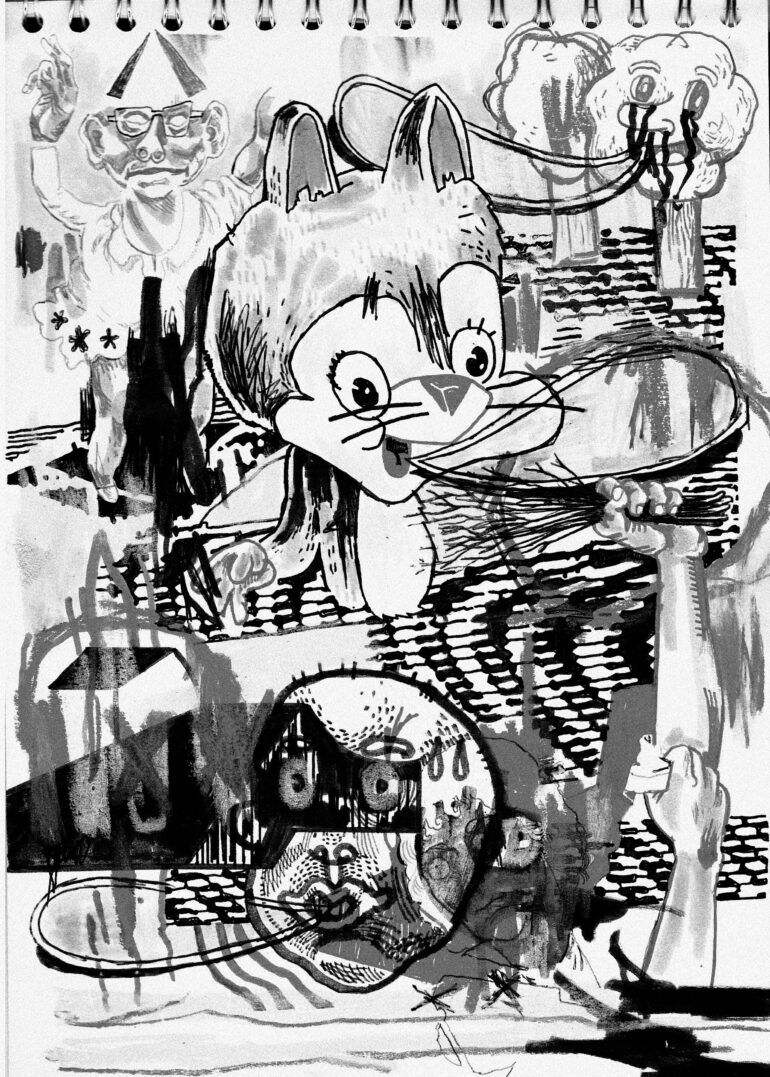
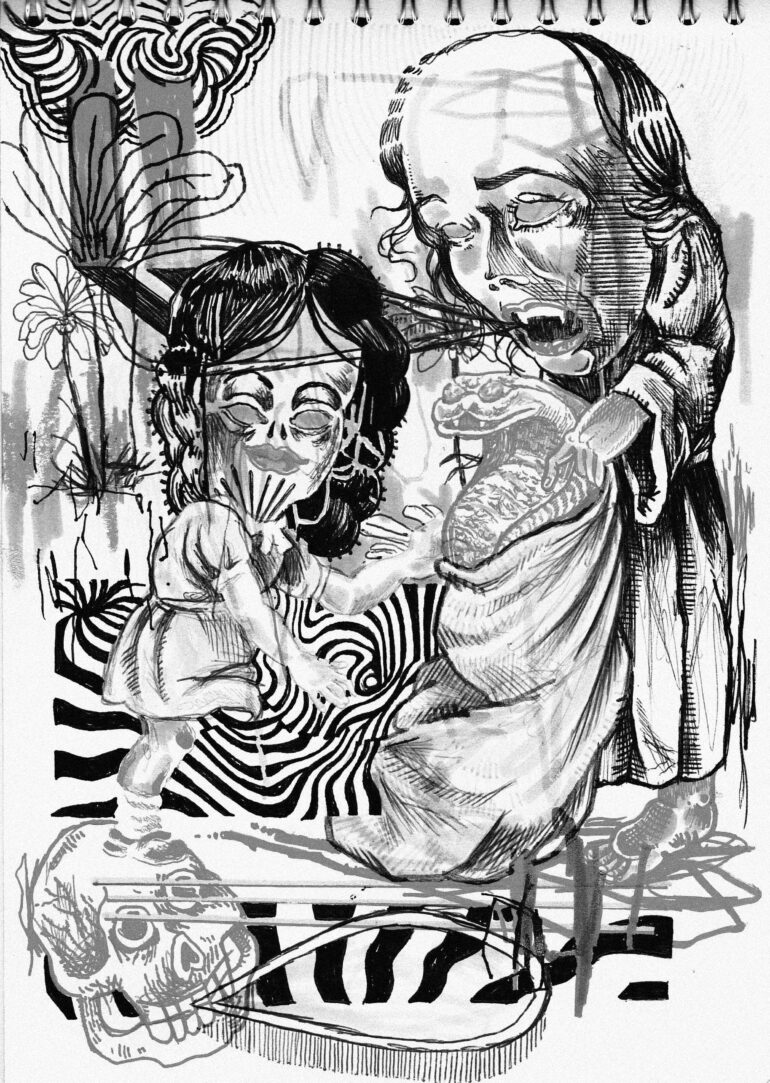
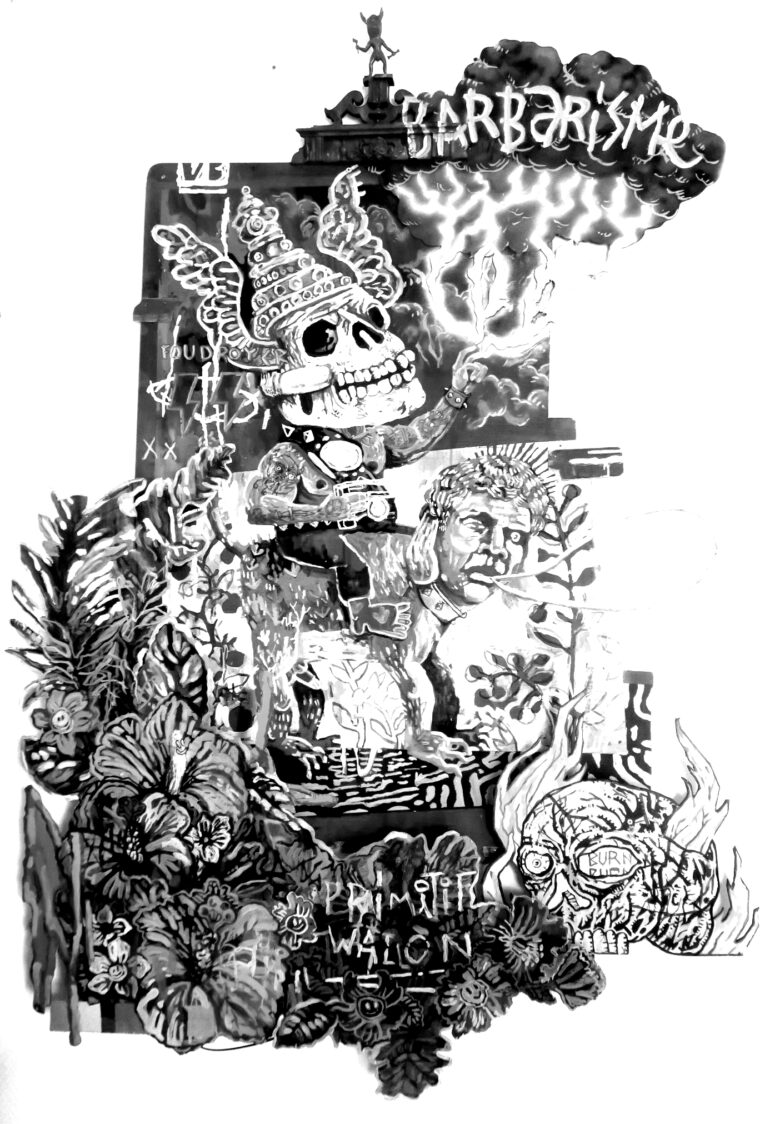
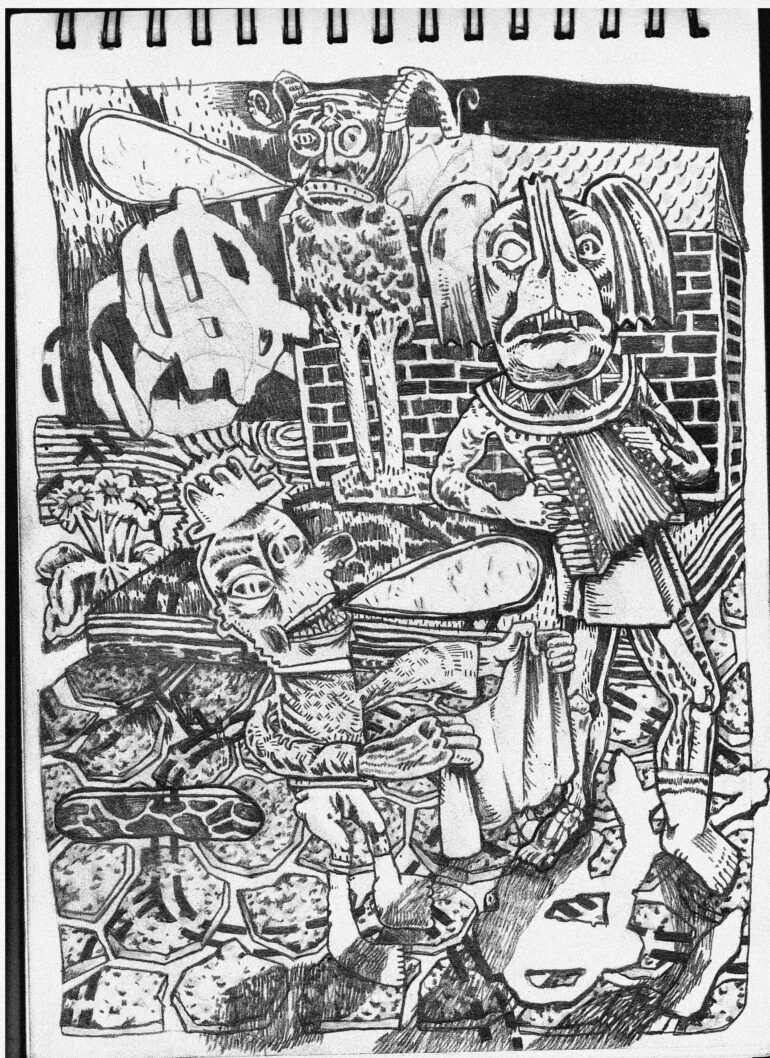
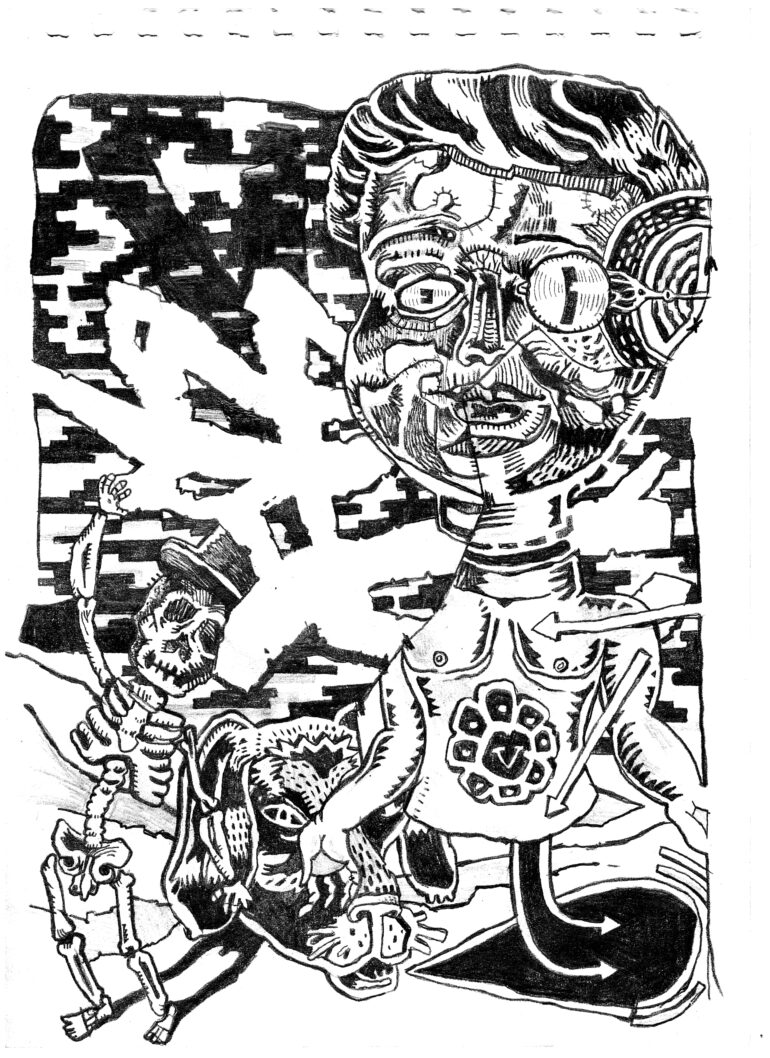
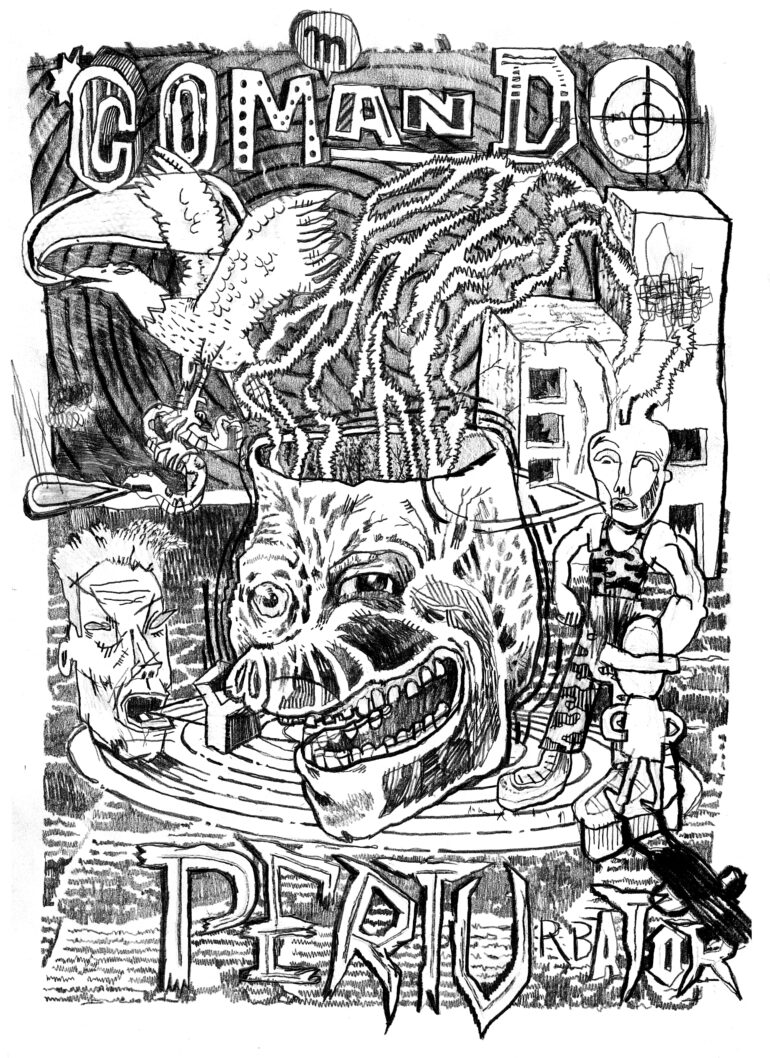
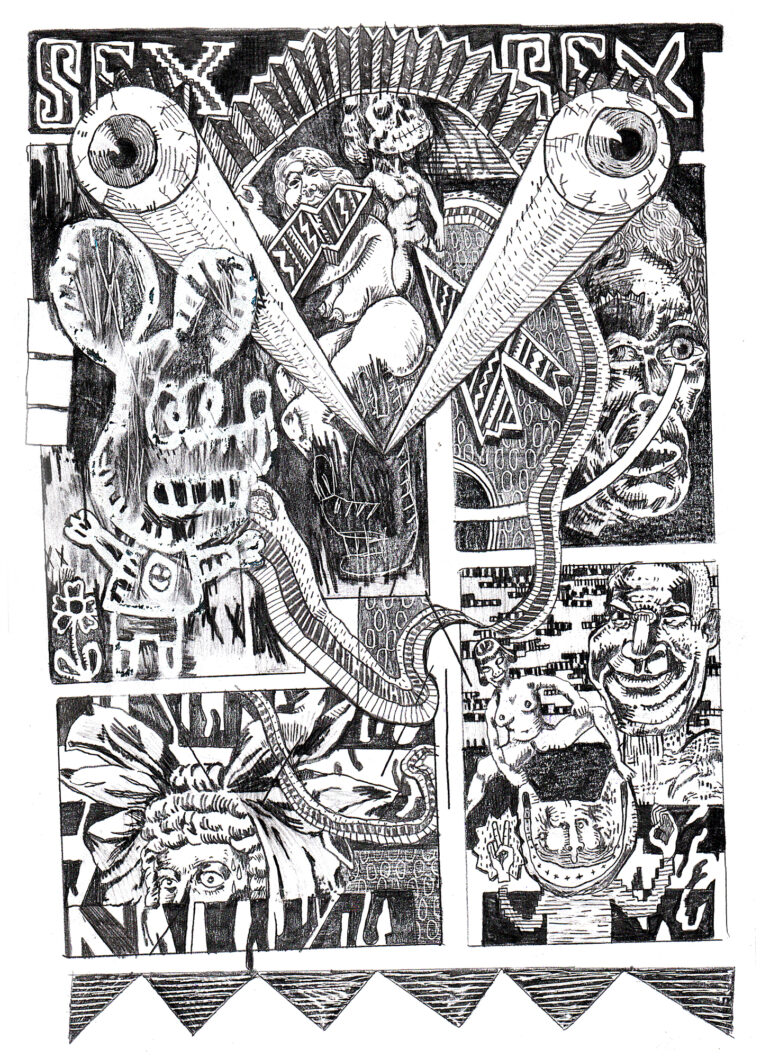

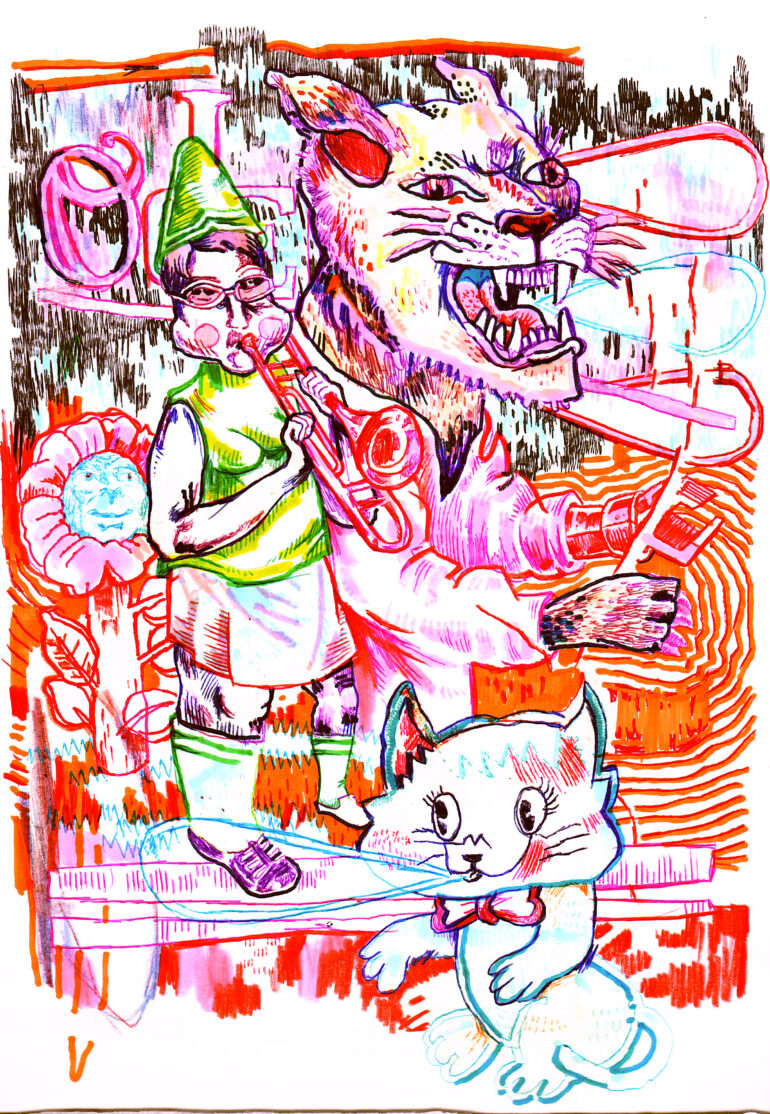
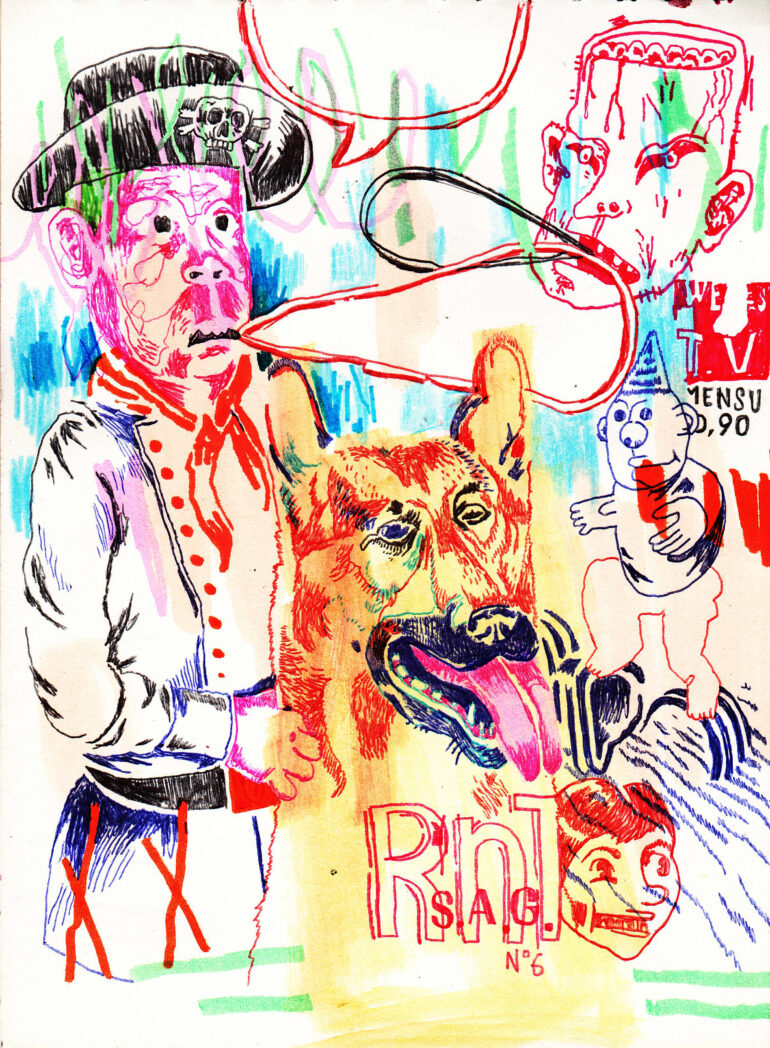
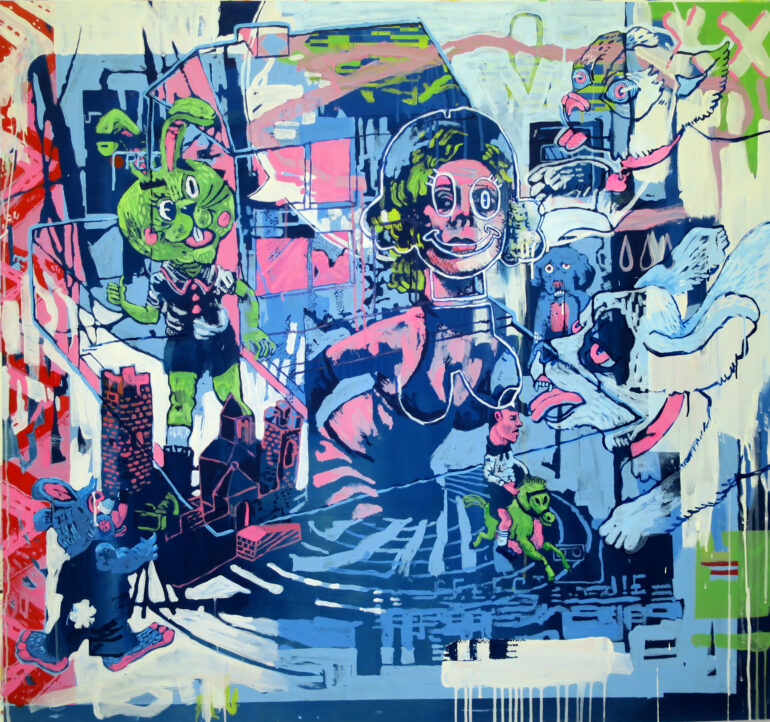

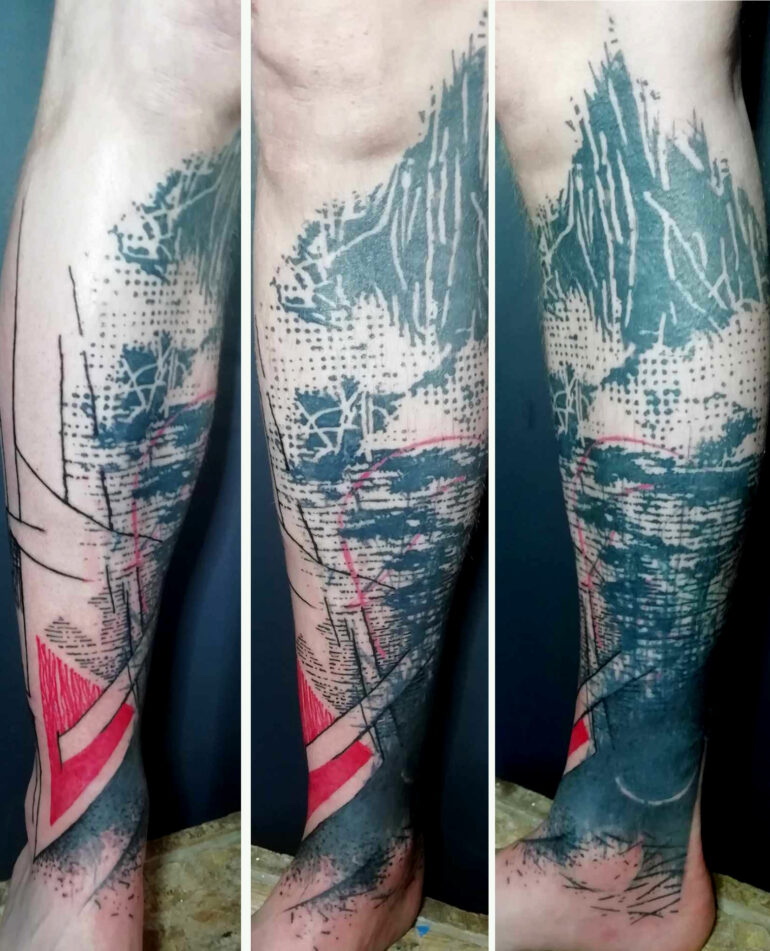
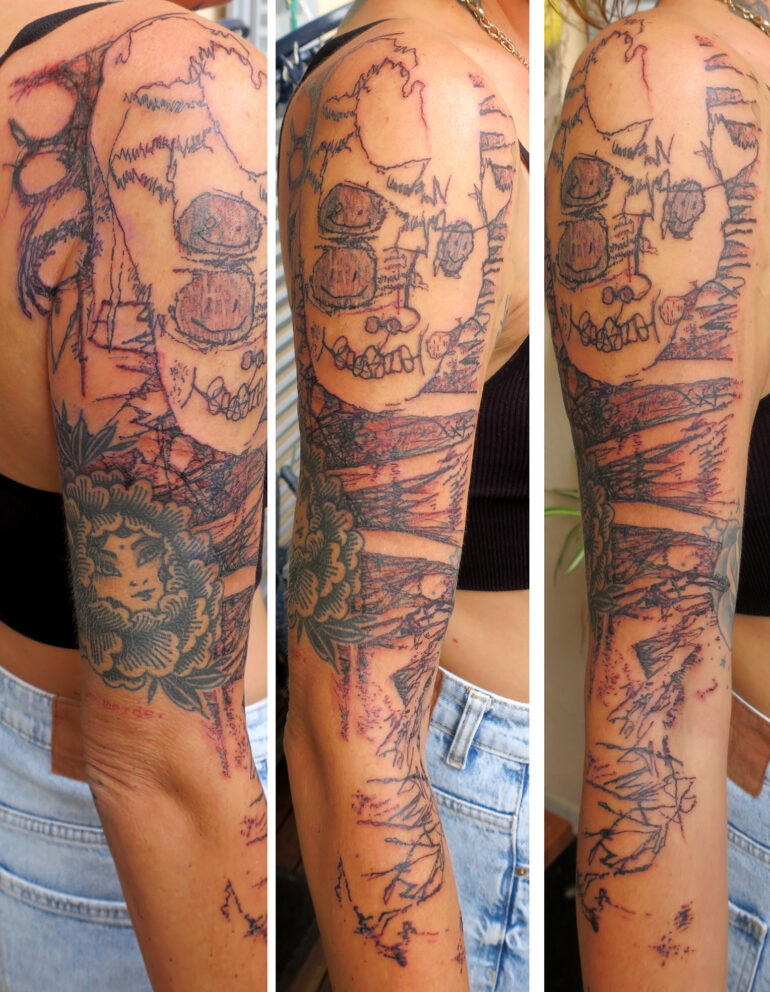
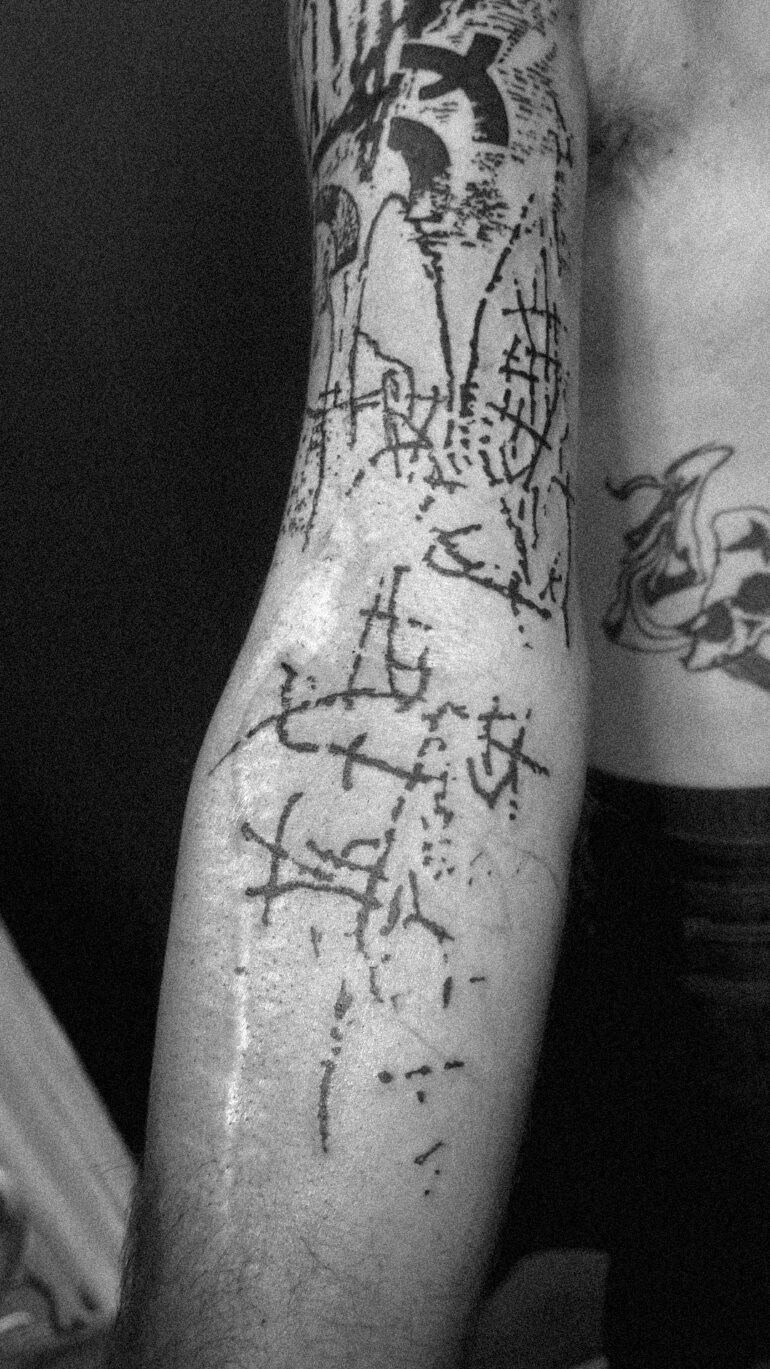
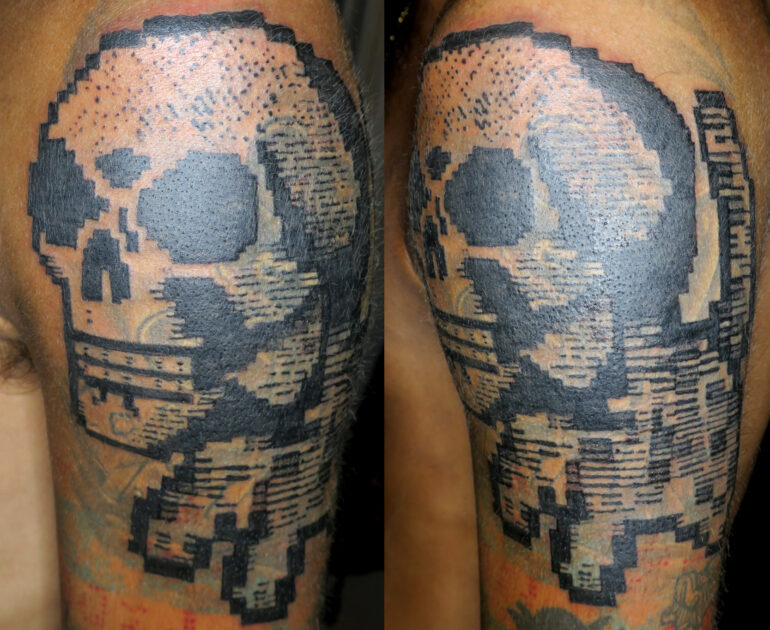
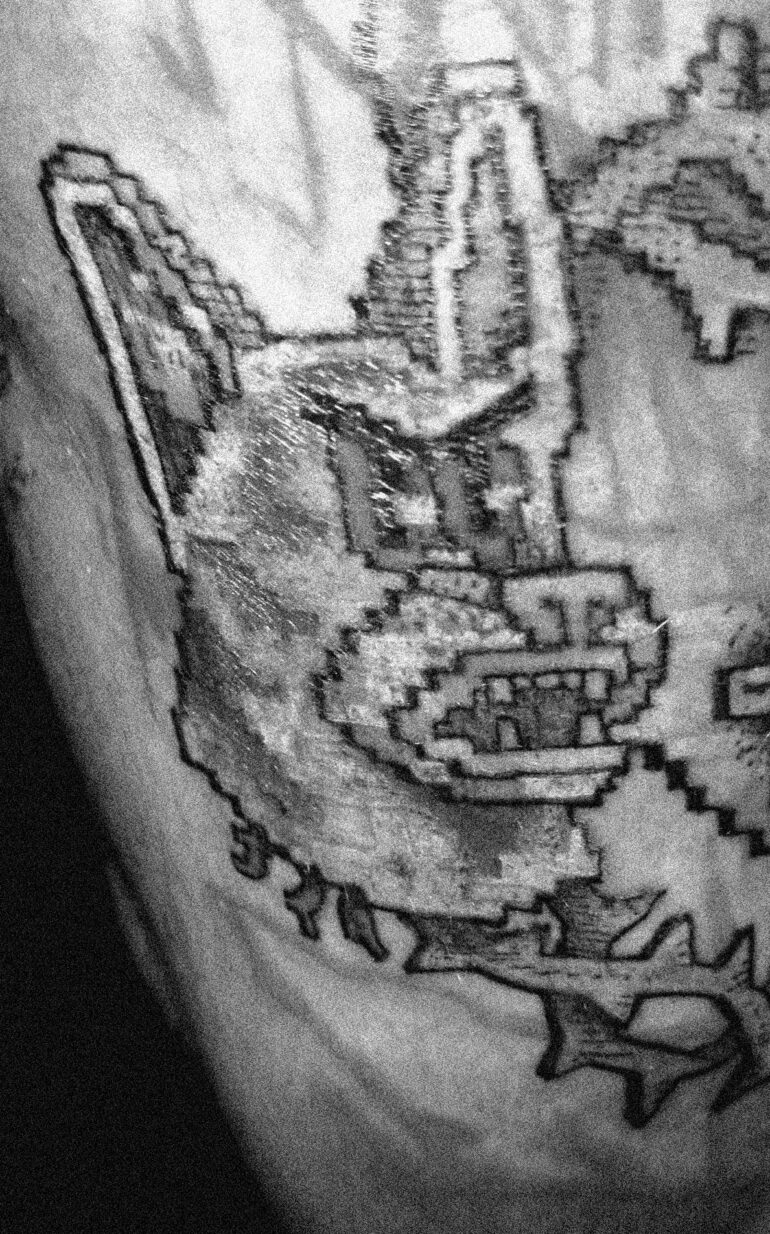
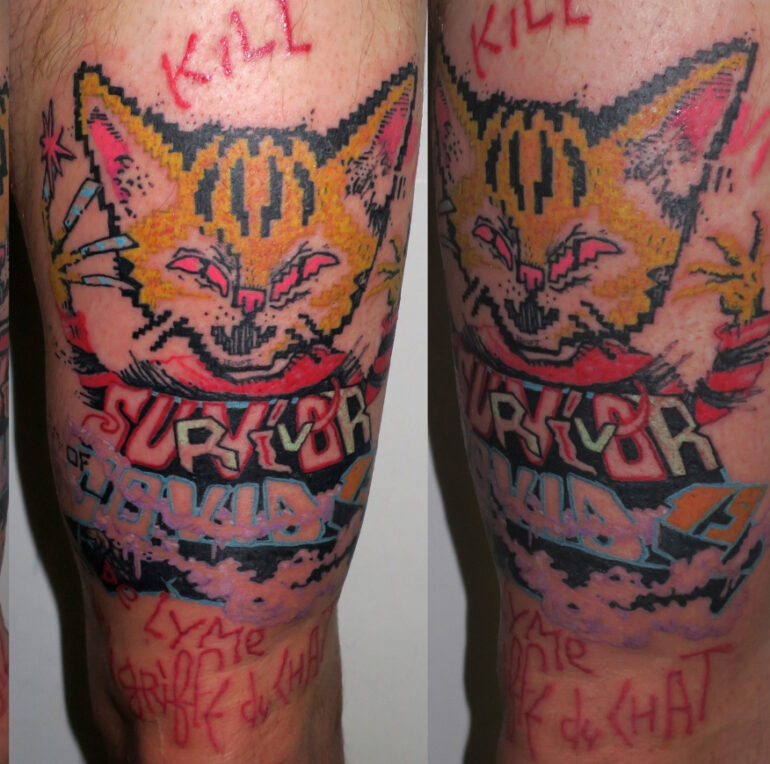
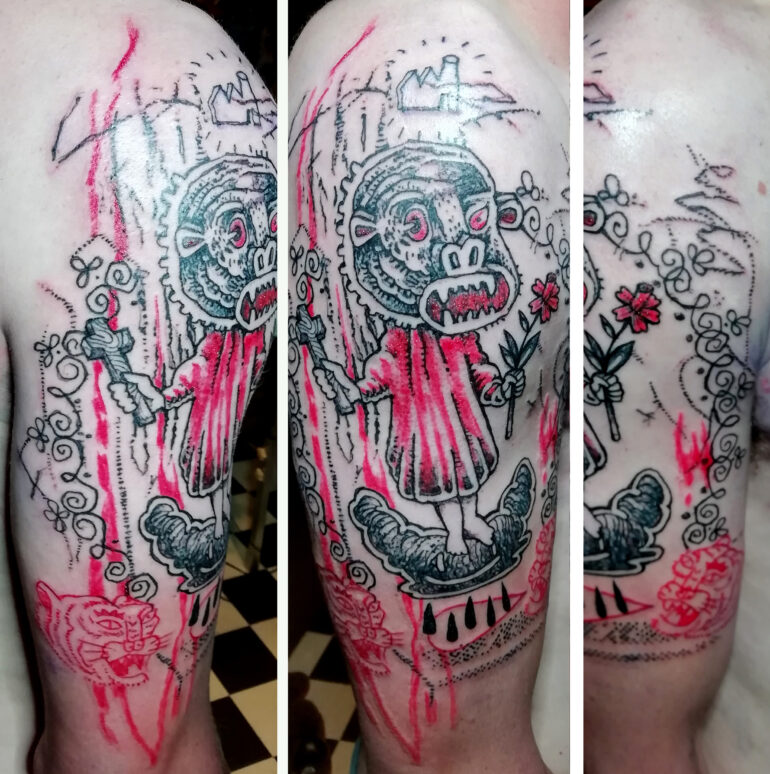
Heading straight to Belgium with Piet du Congo: the guy who just shook up the tattoo guidelines in the early 2000s by combining religious icons, 8-bit aesthetics, with other symbols of all kinds, and also movie posters in a chaotic mash-up of his own! A joyfully deconstructed graphic madness centered around a vibrant love for breakcore, the clash of images, collage, and alternative cultures.
Above all, a cool and approachable guy, closer to lively little bars than cold, sanitized walls of art galleries. Let’s pop open a cold one and have a chat!
| Interview by Polka B.- Translated by Nino Futur

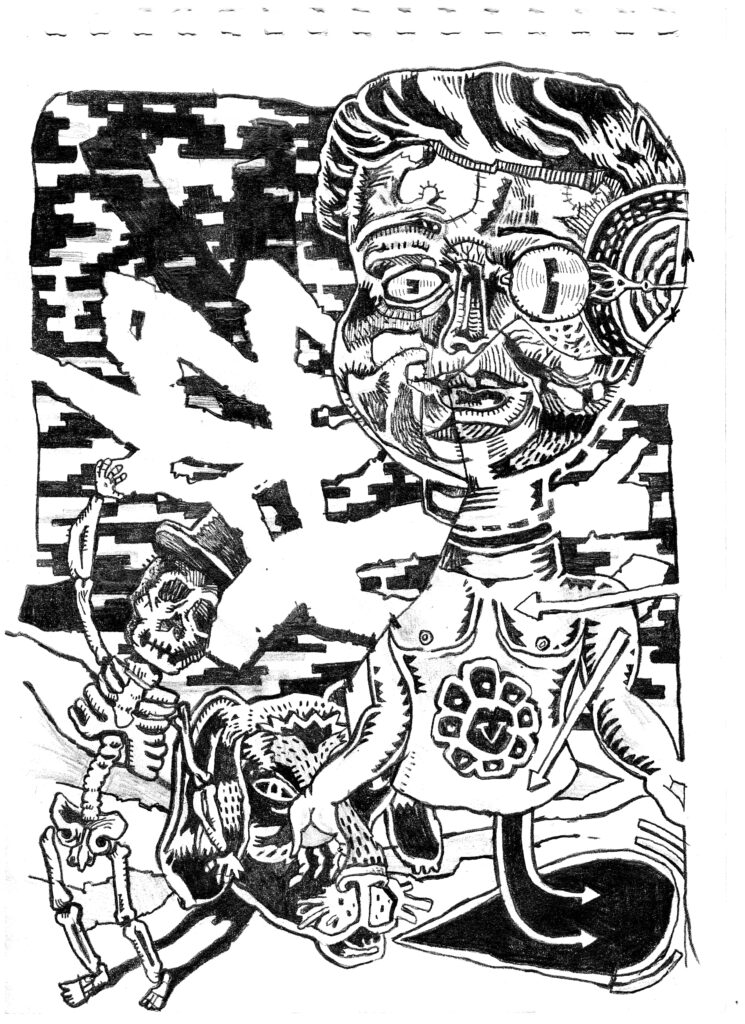
How did you start drawing?
Like many people, I started drawing when I was a child. I wanted to make comics. But I didn’t end up doing that yet! I still started studying visual arts. After leaving school, I was hoarding a bunch of drawings for almost nothing. I almost stopped, so I started working into video and VJing.
When I started getting tattooed, it seemed like itw as a good way to get back into drawing. I liked having interaction with people. I really didn’t get the point of drawing alone in a studio. When you tattoo, it’s a kind of collaborative work with the client.
Now, I draw for myself again, because it’s a space for experimentation that allows me to enrich my work as a tattoo artist, where you have less opportunity to try things out.
In tattooing, you still have to be a little sure of what you are proposing and not make a mistake, unlike with drawing where there are no real consequences.
You seem to give a lot of importance on sharing and exchange. Do you see your art as a vector of connexion with others?
I’ve popular art since the beginning. The idea is to create without imagining that what you do will be framed on a wall. I exhibit in galleries sometimes, but it’s not my primary goal. I thrive more within the music scene.
When I create, I imagine myself sharing all that with people, without projecting myself into a “sacred” space dedicated to art. I like it when the things I make can be translated into real life. When there’s a direct connection with people.
At the time, tattooing wasn’t as popular. What was your mindset in the early 2000s?
I got into tattooing at its turning point. It was still the era of traditional imagery, old school, Japanese, etc. What motivated me was the open-mindedness of guys like Yann Black.
I saw that you could flourish in this discipline by doing very personal things, influenced by all sorts of artistic movements. This vision was still very marginal when I started.
When tattooing became popular (and, in my opinion, commercialized and commodified), I distanced myself from the scene. I avoided studios and conventions. I preferred to travel everywhere to work in more alternative places, preferably music-related.
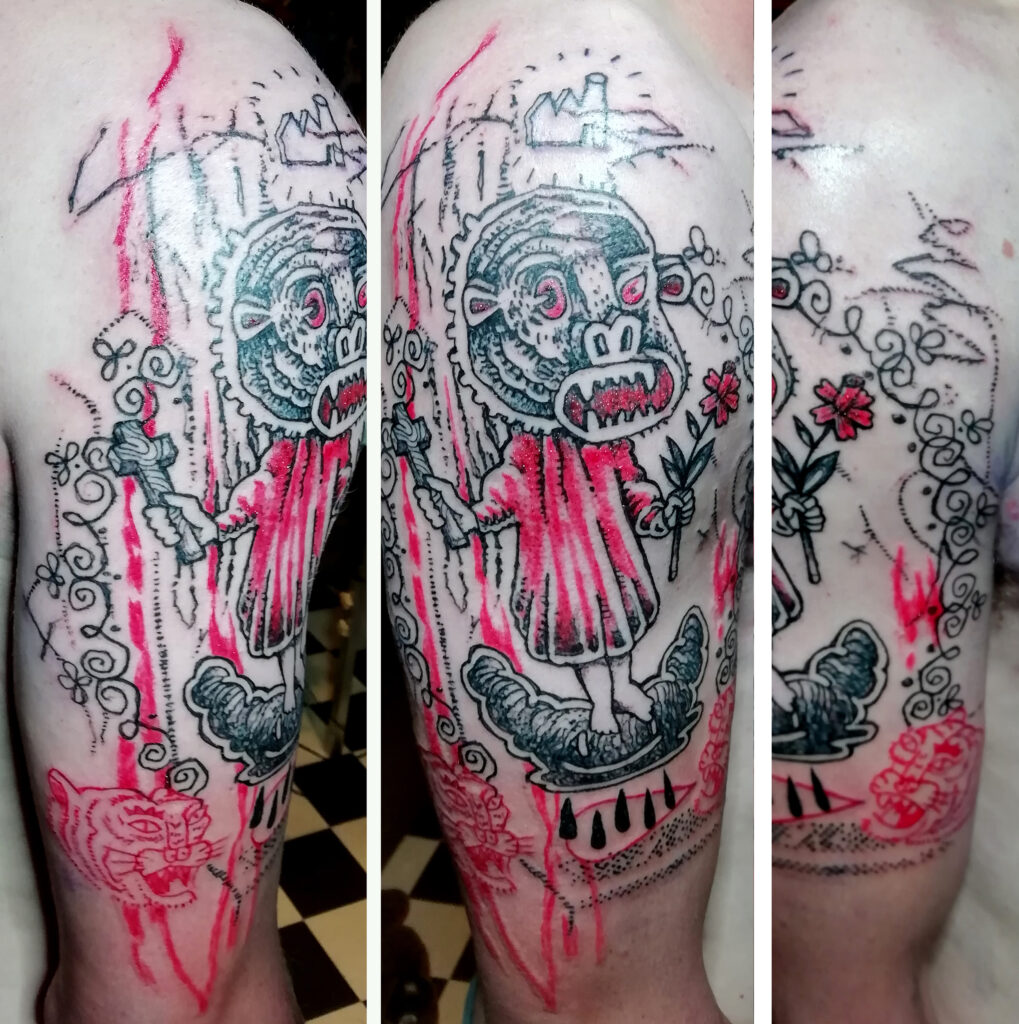
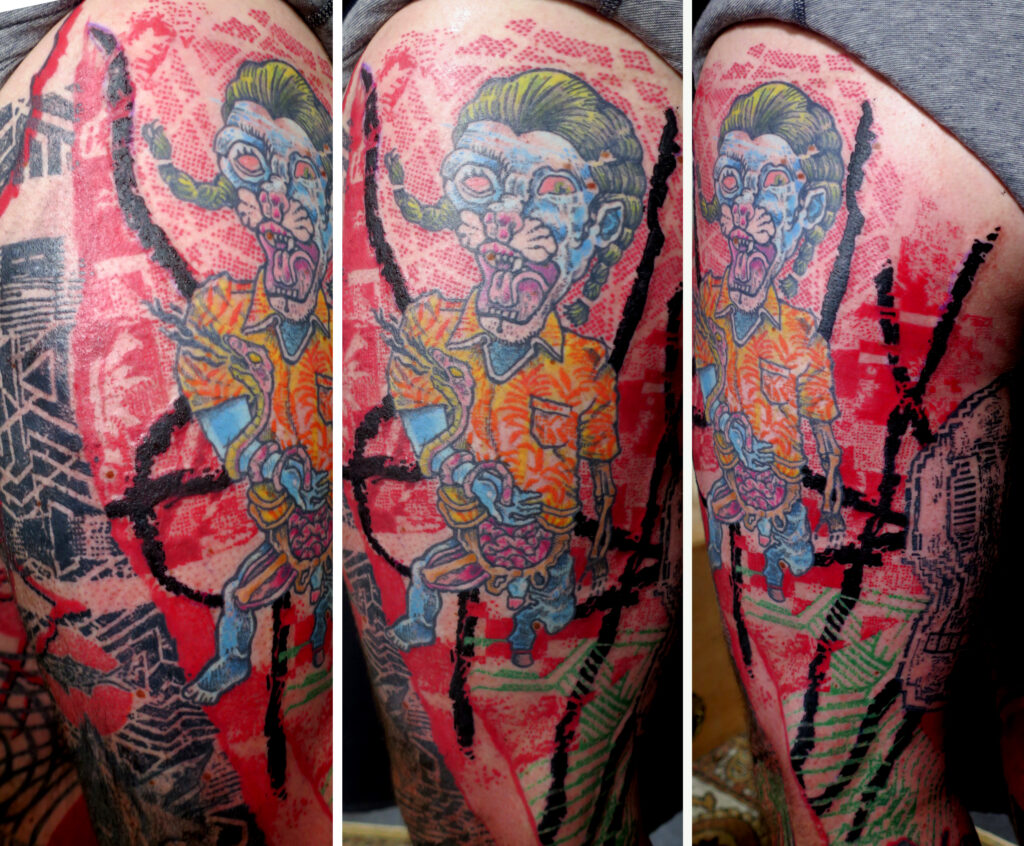
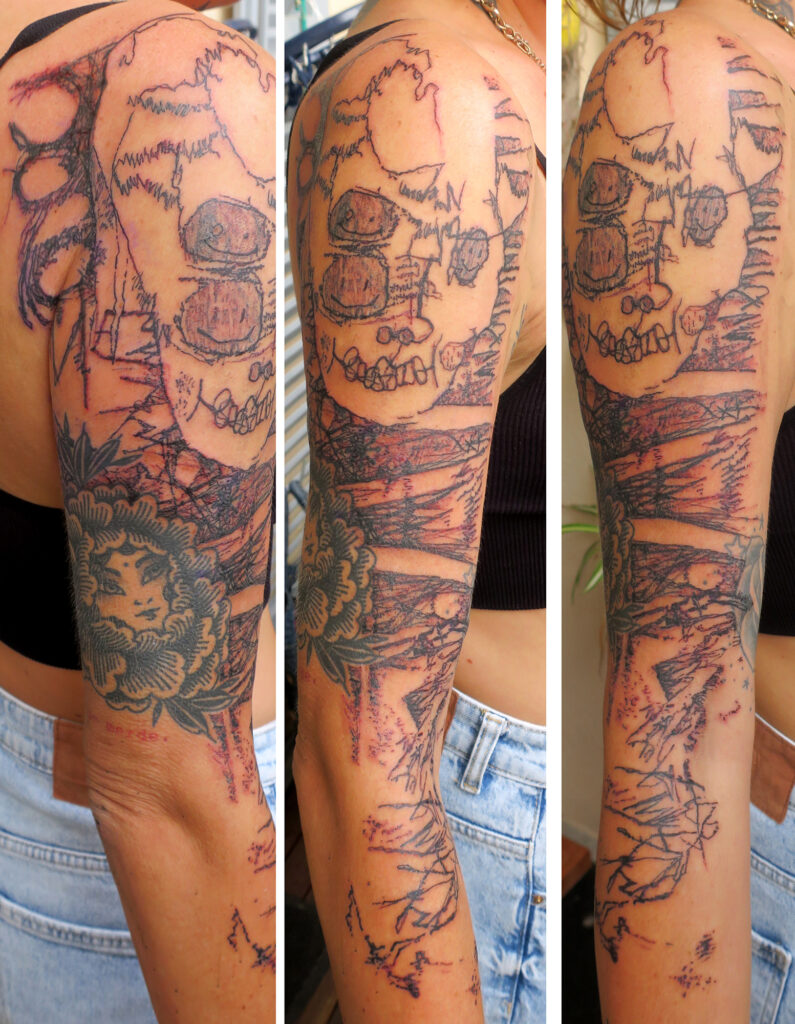
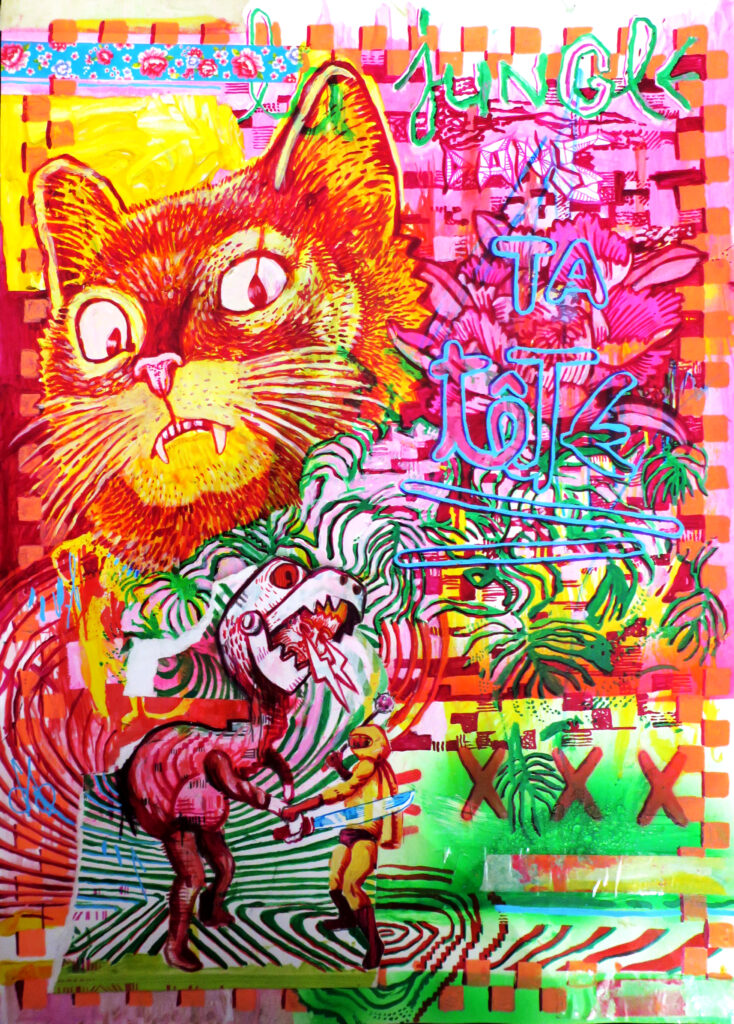
Your style is pretty unique. It’s often associated with “mash-ups”: a kind of graphic collage similar to the practice of sampling into music.
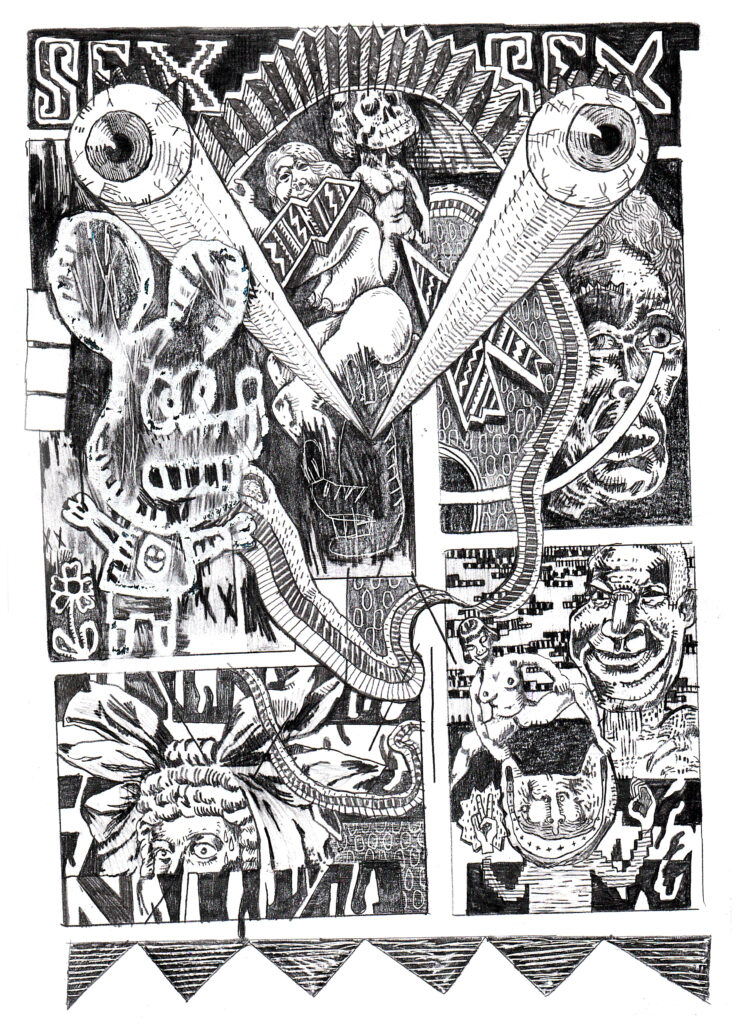
That’s it. It came instinctively. When I make videos, it’s also a collage. I used to see them everywhere on punk flyers, vinyls… I was fascinated by this Dada aesthetic.
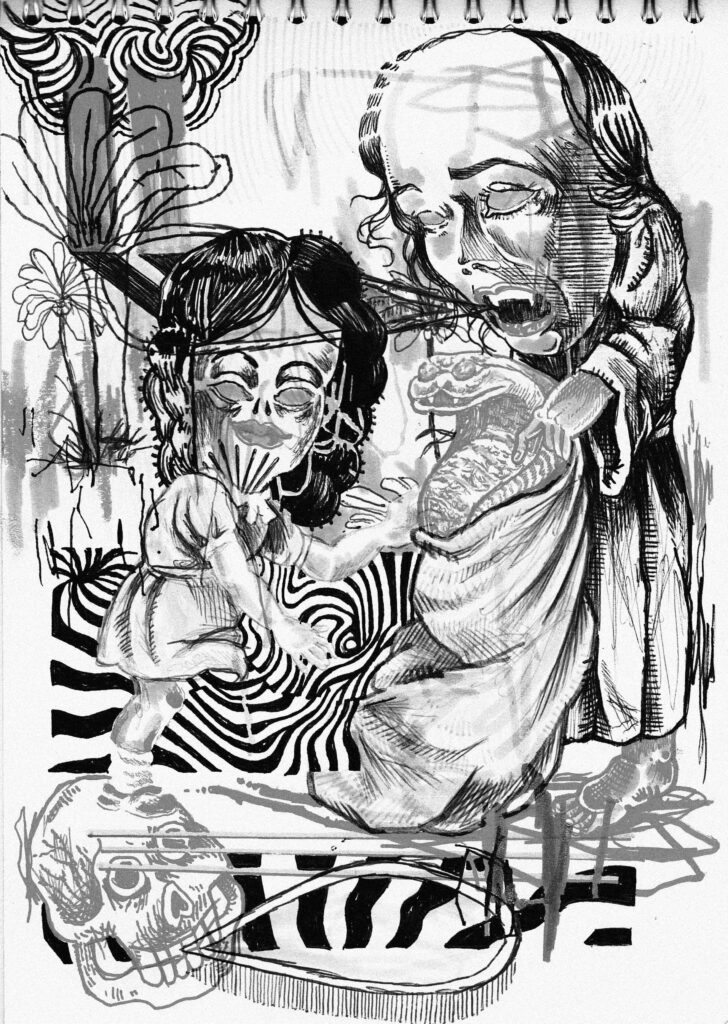
I try not to think too much when I start creating. I want to create an accident. It’s then that I conceptualize or reflect on a meaning.
I come back exclusively to the music. The genre I enjoy mixing live the most is breakcore. This isn’t a coincidence, since it blends all styles of music. It’s also one of the rare musical styles where the dress codes aren’t fixed, just like new wave and industrial. That’s saying something! In this scene, you can find metalheads, electro ravers, rappers… And I like that. I’m influenced by everything around me. I pick and choose from here and there, I’m culturally open. Curiosity fuels my style. I like all my influences blending together.
You also play in an electro-punk band called “Das Pathetick.”
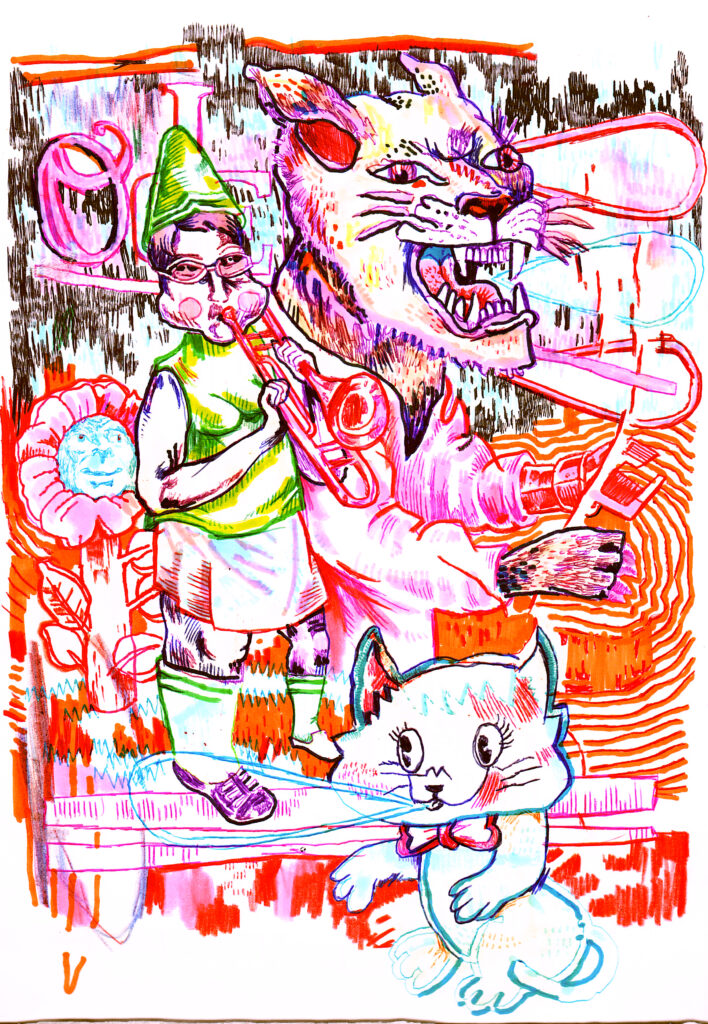
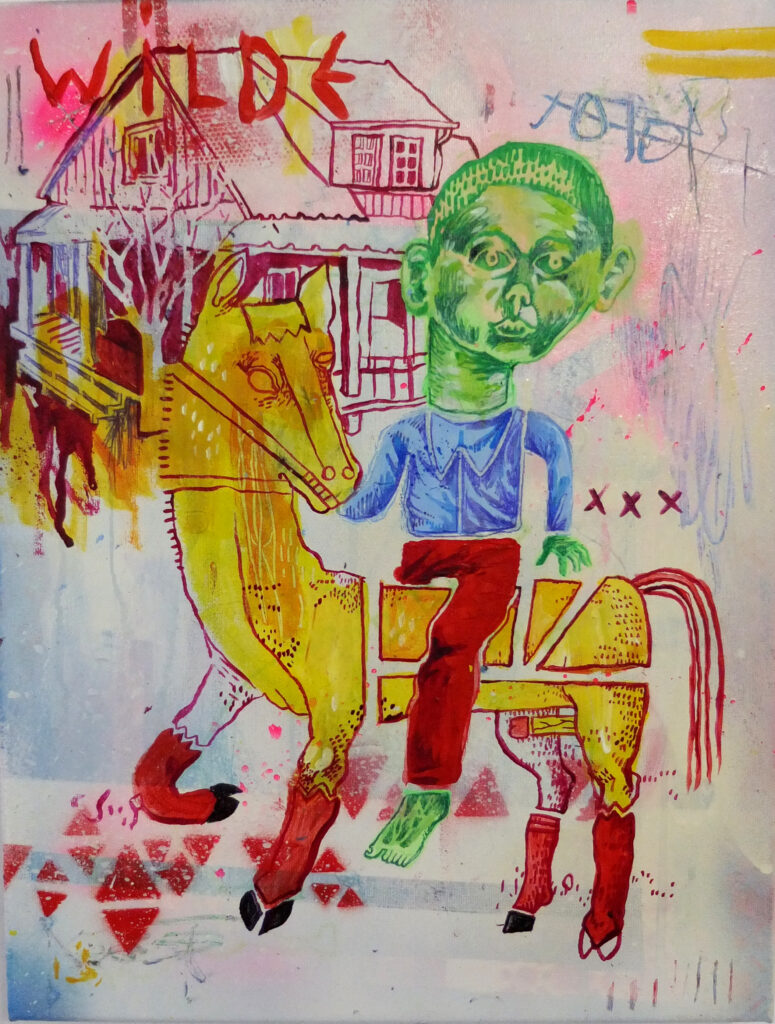
Yes, but the project is over. For now, anyway. Currently, I only do DJ/VJ sets to create an interaction between image and sound. The more hybrid things are, the more interesting they become. It’s the common thread running through all my practices: the delirium of collage, mixed with the desire to make it a public art.
Can you tell us a bit more about the city of Liège?
It seems a bit isolated, and at the same time, a lot of very interesting things are happening there on the artistic side.
I’ve only lived there for three years, but I’ve spent a lot of time there! Anyway, in Wallonia, there aren’t many cities with vibrant alternative scenes.
Liège is afairly poor city with a strong industrial past. The alternative scene is used to having to fend for itself, and DIY has logically developed significantly.
For example, La Zone, an active and self-managed venue since 1988. That’s where I played my first concerts when I was 15. Liège was very crust-punk. The band Hiatus represents the city’s crazyness in the 90s.
You’ve been active in underground scenes for years. What motivates you today? What keeps you going on a daily basis?
I think it’s a need. I hate being inactive. When I draw, when I mix, I’m caught up in what I’m doing. It makes me feel good. The fact that I love DIY so much may also come from a certain administrative phobia!
I’m dyslexic, when I write it’s a disaster. I like doing things on a small scale, orally and with friends. I lived in the countryside for a long time. I quickly understood that if I wanted to see concerts that I liked, I had to organize it myself! This culture has always been part of my life.
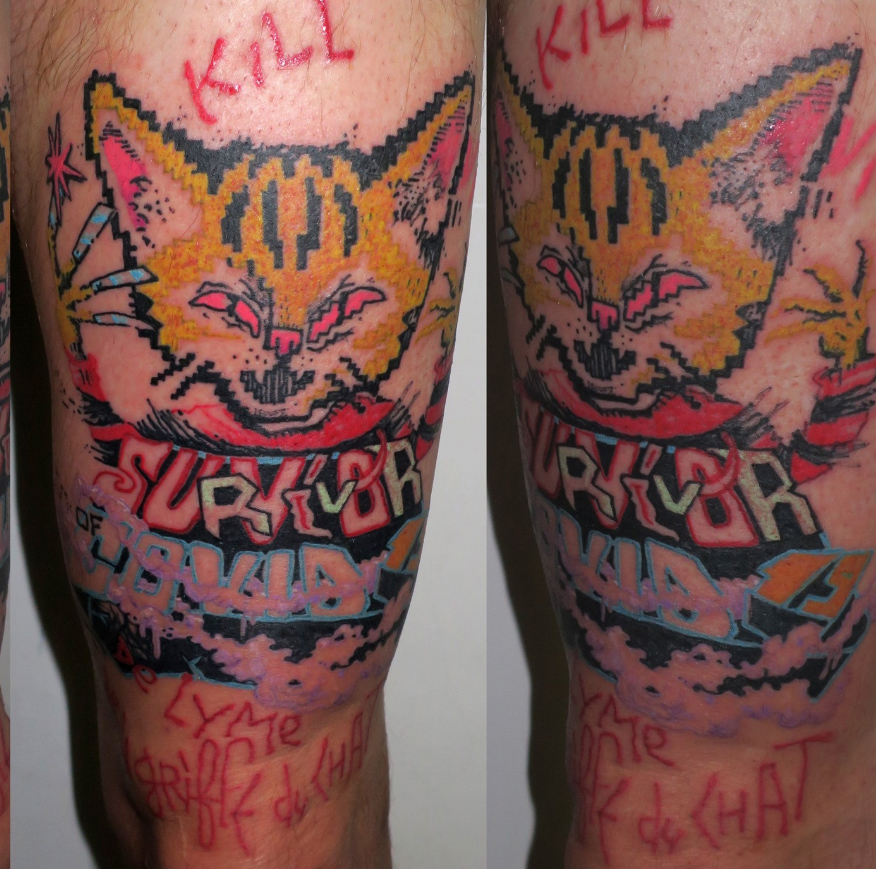
You’re often mentioned among European tattoo artists who incorporate raw art into their creations.
Looking back, do you think you’re one of the pioneers of the mash-up movement into tattoo?
It would be a bit pretentious of me to say that. But I can say that when I started out, there were really very few of us involved in this style. In the drawing world, you could find plenty of people doing this style.
I was probably one of the first to want to integrate this type of aesthetic into the tattoo world that was still very conservative at the time. Very traditional. I don’t think anyone invents anything. Nothing is pure. There’s only recycling and reinvention, constantly.
If you didn’t invent it, you may have helped popularize it.
I’m one of those who wanted to bring back the dirty things, into something that was becoming a bit clean. Everything is cyclical.
With the popularization of tattooing, we started to lose our radicalism. Quite logically, tattoo fans who liked this aspect sought out this extreme side by pushing it ever further in form. As everyone started getting tattoos, it was necessary to recapture that edgier spirit of the early days. So the cursor shifted. This opened a lot of doors, like ignorant style, which reconnects with the original approach to tattooing.
Oh, we totally forgot to ask you. Why “Piet du Congo”?
It all started with a stupid joke about porn actors names. To find their name, they used the name of their street and their middle name. At the time, I used to live on Rue du Congo… Quite simply.
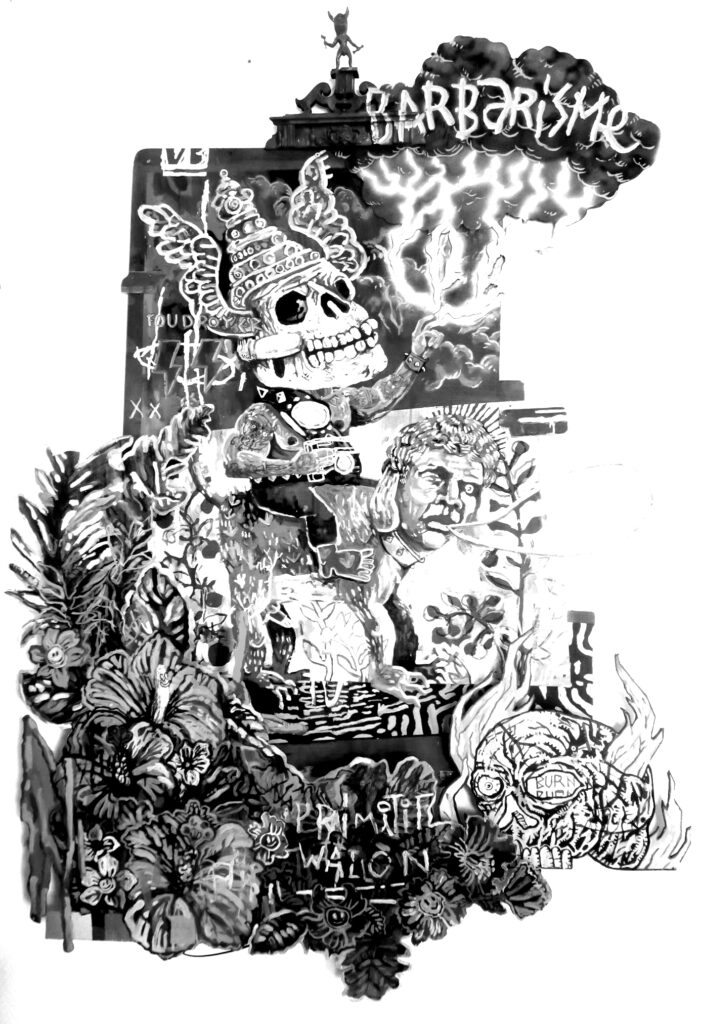
My real name is Pierre-Allan. And “Piet” is Pierre in Dutch. It made me laugh, because I have absolutely no family roots there. And even less so in Congo, especially since it’s not one of Belgium’s most glorious pages… I just liked this idea of a false identity that doesn’t really make sense. It goes back to this idea of collage.
Can you leave us with some musical recommendations that you think represents your world well?
The most complicated question for me! I consume so much music… In terms of what represents me, I want to mention Ladyscraper, who mixes breakcore and metal influences.
To mention something a bit intellectual, I’m thinking of Glenn Branca. He comes from a classical background and has had a huge influence on rock bands like Sonic Youth. He makes tracks for electric guitars, based around very slow compositions.
And on the hip-hop side, I really dig BACKXWASH, who develops a hybrid doom sound with super interesting voodoo imagery.